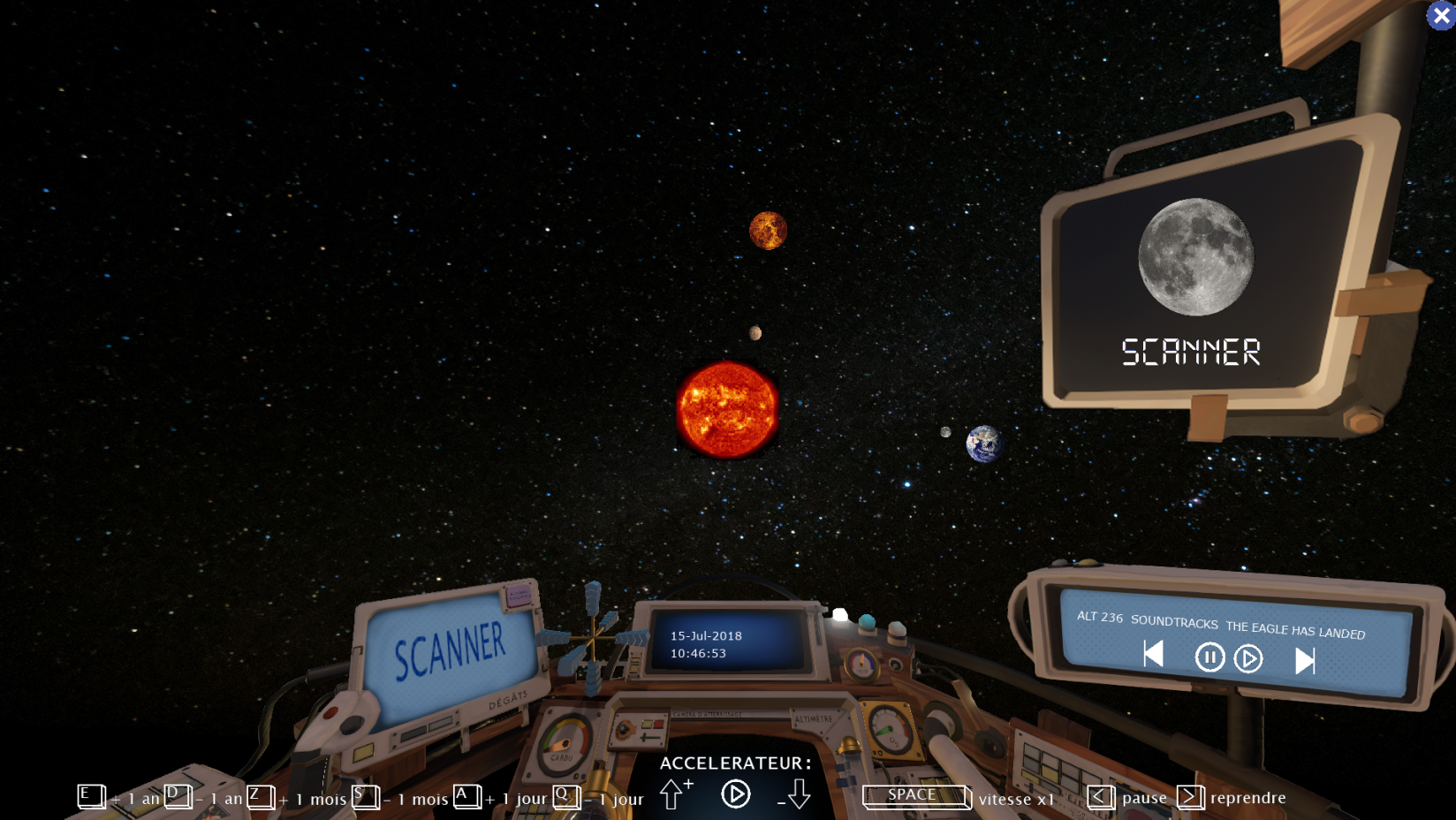
Description
Ksi is a school project developed in Python by Théo Polgar, Élias Ephrem-Boustany and Guillaume Rabeau, designed to simulate the positions of planets over time. This application calculates and displays the real-time positions of celestial bodies in our solar system based on specified time parameters. Leveraging astronomical algorithms and precise data, Ksi provides an accurate and educational visualization of planetary movements. The project showcases proficiency in Python programming, algorithm implementation, and a solid understanding of orbital mechanics.
Key Features
- Real-time Simulation: Accurately simulates the positions of planets at any given time.
- User Interface: Provides an intuitive interface for users to input time parameters and view planetary positions.
- Educational Tool: Serves as an educational resource for understanding planetary orbits and celestial mechanics.
- Algorithm Implementation: Utilizes advanced algorithms for precise astronomical calculations.
Technologies Used
- Python: Core simulation engine and orbital algorithm implementation.
- NumPy: Astronomical calculations and numerical methods.
- Matplotlib: Visualization of planetary positions and movements.
- Jupyter: Prototyping and exploratory computation.
My Role
Ksi was my first real team coding project. I worked with Théo Polgar and Élias Ephrem-Boustany, mostly on the input interfaces and the visualization layer. I spent a lot of time making sure the simulation results were both mathematically sound and visually understandable for users who were not astronomy experts.
What I Learned
Before this project, I thought code was about getting the right answer. Ksi taught me that the right answer is useless if no one can use it. Building UI around a complex model forced me to think about the human side of code for the first time.
Outcome
Successfully created an interactive and educational application that aids in the understanding of planetary positions and movements, demonstrating strong programming skills and knowledge of astronomy.